
Steel Manufacturing Process: A Complete Industrial Guide to Modern Steel Production
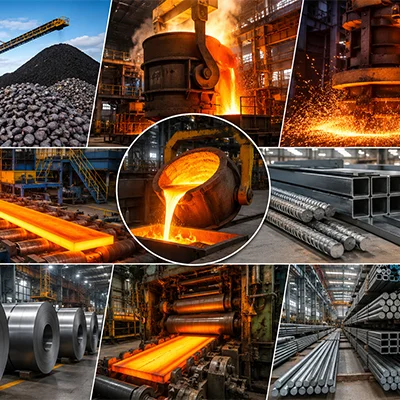
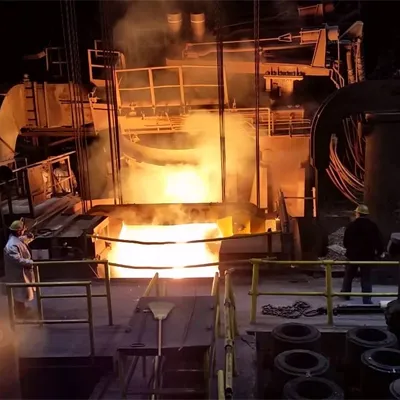
One of those things that people take for granted until they step into a plant that produces it is steel. The first impression is usually noise, heat, and scale. Everything is oversized—conveyors moving endlessly, furnaces glowing like something alive, and molten metal being handled with a precision that feels almost unreal when you see it up close.
Yet behind all that intensity, steel production is still a structured process. It has rhythm. It has logic. And once you understand how it flows from raw material to finished product, the entire system starts to make sense.
Where it all begins — and why raw materials matter more than people think
Steel doesn’t start in a furnace. It starts in mines, scrap yards, and stockpiles that don’t look impressive at first glance.
Iron ore is the classic starting point in integrated steel plants. On its own, it’s not usable. It carries oxygen and impurities that must be removed later. Coal is brought in as well, but not in its raw form. It is converted into coke first—a process that removes unwanted gases and leaves behind a material that can survive extreme furnace temperatures.
Then there’s limestone, often overlooked, but absolutely essential. It helps pull impurities out during melting. Without it, the entire process becomes unstable.
In many modern plants, there’s a fourth raw material quietly changing the industry—scrap steel. All old machines, dismantled structures, manufacturing waste will be returned. Steel is one of the few materials that can be recycled ad infinitum without the loss of key material properties. This is all it took to alter the whole way the industry works now.
Preparing materials — the stage nobody talks about
Before anything reaches the furnace, there’s a long preparation phase that doesn’t get much attention outside the industry.
Iron ore is rarely used as it comes from the mine. It is crushed, cleaned, and sorted. In many cases, it is turned into pellets. This isn’t cosmetic—it’s practical. Uniform size means uniform behavior inside the furnace.
Coal goes through a completely different transformation. It is baked in sealed ovens without oxygen. What comes out is coke: lighter, porous, and far more stable under heat. If this step is done poorly, everything downstream suffers. Operators know this well.
This stage is slow, unglamorous work, but plants depend on it more than they admit.
The blast furnace — still the most dramatic part of steelmaking
If there is one section of a steel plant that leaves an impression, it’s the blast furnace.
It doesn’t really shut down once it starts. It is started up and run on continuously, often for many years, and with brief maintenance periods. When you're close by, you don't see it, you feel it.
From the top, layers of iron ore, coke and limestone are added inwards. From the bottom, hot air is blasted upward. The reaction is immediate and violent in chemical terms. Coke burns, producing carbon monoxide. That gas strips oxygen from iron ore. The rest is molten iron which collects at the bottom of the furnace.
During this process, impurities are caught up in the limestone and are ejected on the surface of the molten iron as a separate slag layer.
Operators tap the furnace periodically to remove both materials. The iron moves forward for refining. The slag is removed and often reused in construction applications.
What comes out is called hot metal, but it’s not steel yet. It still carries too much carbon and needs further treatment.
Turning iron into steel — where precision actually begins
This is where things shift from “bulk production” to controlled metallurgy.
Basic Oxygen Furnace is employed in most of the integrated plants. It's an easy concept but a tough execution.
The molten iron is poured into a large vessel. Blown in O2 at extremely high velocities. Carbon content drops quickly, and unwanted elements are stripped away. The reaction generates heat, so the metal stays molten without external fuel.
But this stage is not just about removing impurities. It’s about hitting targets. Different industries want different steel. Construction steel behaves differently from automotive steel. Pipeline steel has its own requirements. Even small changes in composition matter.
This is the point where steel starts becoming a “designed material” rather than just processed metal.
Electric arc furnace route — the quieter revolution
Not every steel plant follows the blast furnace route anymore.
The operating conditions of Electric Arc Furnace (EAF) plants are different. They do not begin with iron ore, but with scrap steel. This changes the whole scenario.
Electric arcs are created within the furnace by the graphite electrodes. The temperature increases very rapidly and enough to melt a scrap within a few minutes.
It’s like a very elegant system. No coke ovens. No blast furnace towers. Just electricity, scrap, and controlled melting.
EAF plants are flexible. They are able to begin and end more rapidly. They are heavily making use of recycled materials, decreasing tension on mining, and raw materials offer chains. That's why many newer steel facilities opt for this method, particularly when they have sustainability goals.
Two systems, one outcome
The purpose of steel either from an integrated plant or an EAF plant is the same. It's just the way in which the journey begins.
Integrated plants are built for scale. Everything is large, continuous, and designed for high-volume production.
EAF plants are more adaptable. They respond faster to demand and are better aligned with recycling-based production.
Both are now essential. Neither is replacing the other completely.
Refining — the stage that decides the final quality
Once steel is formed, it still isn’t ready.
It goes through secondary refining, which is where chemistry is fine-tuned. Depending on the use of the steel, elements such as chromium, nickel, manganese and molybdenum are added.
Sometimes gases are removed. Sometimes temperature is adjusted with precision. Sometimes impurities are reduced to extremely low levels that can’t be seen but still affect performance.
This stage is less visible, but it is where steel becomes specialized.
Continuous casting — turning liquid into something usable
Molten steel doesn’t stay liquid for long once refining is complete.
It is poured into a continuous casting system where it begins to solidify while still moving. There are no individual molds anymore in modern plants. But steel can be continuously processed and is extruded as slabs, billets or blooms.
It feels like a transition point in the process. One moment it’s liquid metal. A few meters later, it’s a solid form ready for rolling.
This system changed steel production significantly because it reduced waste and improved consistency.
Rolling — where steel becomes recognizable
Rolling mills are where steel starts looking like something you’d actually see in daily life.
Hot rolling shapes steel while it is still at high temperatures. This is where structural beams, plates, and heavy coils are formed.
Cold rolling happens later. It improves surface finish and dimensional accuracy. This is the steel used in cars, appliances, and precision parts.
At this stage, the material finally takes its “final identity.”
Quality control — constant, not optional
One thing that becomes clear in real plants is that quality is not checked at the end. It is checked everywhere.
Chemical testing, mechanical testing, ultrasonic inspection – all of these occur during the entire manufacturing process – not just the end stage.
Steel is used in places where failure is not an option. That is why control is continuous, not occasional.
Where steel manufacturing is heading
The industry is changing but not in a way that's going to replace all of the old.
The blast furnace is still used. EAF plants are growing. New technologies like hydrogen-based ironmaking are being tested, not fully deployed.
Digital monitoring systems are becoming more common. Plant now monitors processes in real-time, and may even modify processes automatically.
The message of the direction is clear: reduce waste, increase recycling, reduce control and increase clean production.
Final thought
Once steel production is understood, it can be described as a process, but it's not that simple.
It's more of a system that is constantly developing. There is a raw material at one end and at the other end well-crafted products, but there is chemistry, heat, timing and experience in between that no one diagram can explain.
That's how steel production has continued to be one of the most important industries in the world.
 Media Pack Download
  Newsletters
  Industrial Events